
Bend, Oregon · Family-owned since 2014
Commercial Appliance Repair Bend
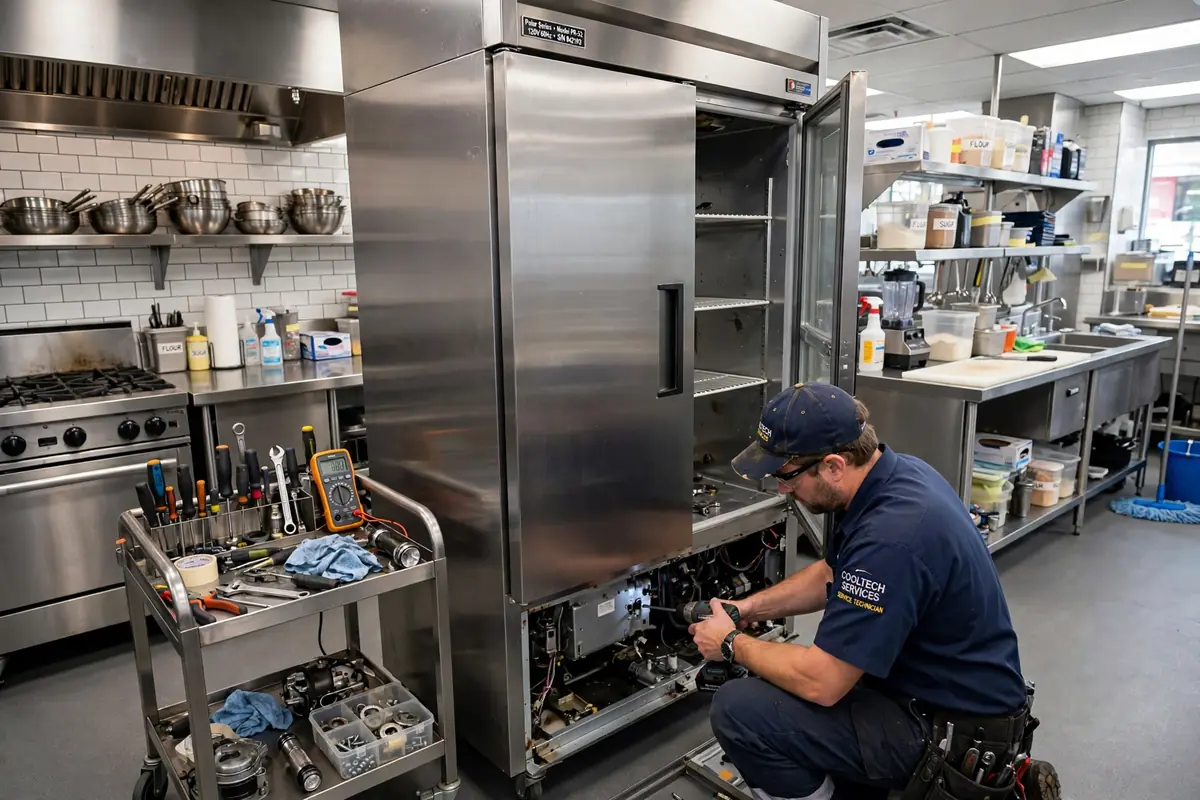
A broken commercial fridge can cost a restaurant a day of trade. An ice machine down on a hot weekend is worse. Our Bend team fixes commercial appliances fast, because downtime is lost money.
Also searched as: commercial appliance repair bend or · commercial refrigerator repair bend or · commercial appliance repair in Bend.
On every visit
- 1Call or book online
- 2On-site diagnosis — upfront flat-rate pricing
- 3We fix it fast with genuine OEM parts
- 490-day parts and labour guarantee
Mon–Sat 8am–6pm · 56857 Enterprise Dr, Sunriver, OR 97707, USA
Since 2014
Family-owned in Bend
Licensed & insured
Local team, not a call centre
Bend · Redmond
Central Oregon served
Mon–Sat 8am–6pm
Call for a visit
Commercial appliance repair Bend covers reach-in fridges, walk-in coolers, ice machines, commercial dishwashers, ranges, and fryers. We work with restaurants, cafes, and shops across Bend, Redmond, and Central Oregon.
Commercial units work harder than home units, because doors open all day and coils collect kitchen grease and dust. We check door gaskets, coils, and fans first, because those three cause most commercial faults.
What to know before you call
- Commercial appliance repair bend technicians see compressor deterioration, condenser contamination, and door gasket failure after years of high-volume operation.
- Doors open constantly, ovens cycle repeatedly, and dishwashers run continuously. Gaskets wear fast as staff admit warm air hundreds of times daily.
- Bend hard water leaves sediment accumulation inside ice machines, dishwashers, and steam equipment, reducing efficiency and accelerating internal corrosion.
- Coil cleaning, gasket checks, and temp settings keep cooling strong and stop peak-time breakdowns. Our family-owned team has served Bend, Redmond, and Central Oregon kitchens since 2014.
- All commercial repairs carry a 90-day warranty, with a diagnostic fee confirmed when booking. Call (541) 422-4646, Monday through Saturday, 8am to 6pm, for downtown dining rooms and Old Mill District establishments.
Bend's food scene runs from downtown restaurants to Old Mill District cafes and Sunriver resort kitchens. Tourist weekends in summer put extra load on every fridge and ice machine. A unit that copes in winter can fail on a busy July Saturday. We plan for peak load, not just average load.
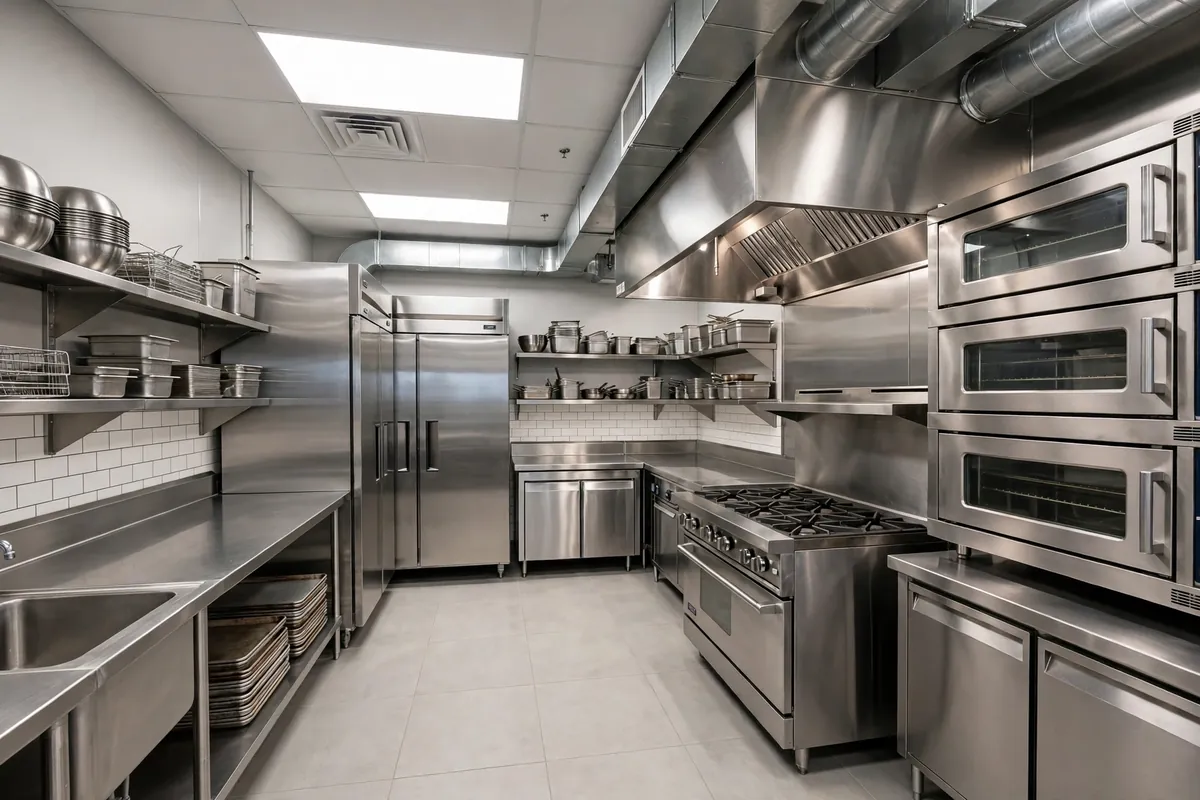
Commercial appliance repair Bend begins with understanding how restaurant kitchens operate, with refrigeration, cooking, and dishwashing equipment running constantly. Reach-in fridges, walk-in coolers, and ice machines need steady cooling flow, while dishwashers need exact temp control to sanitize. Grease accumulation, hard-water sediment, and constant door openings accelerate deterioration, forcing compressors, condensers, and evaporator fans beyond comfortable capacity. A full check finds flow blocks, wrong temp settings, and worn parts before small faults spoil a busy weekend. Downtime costs revenue, damages reputation, and risks food safety, so rapid diagnostic response protects your business and your customers.
01 — Symptoms
Signs your commercial appliance needs attention
These are the faults we see most often in Bend homes, and every one has a clear cause. Each fault also has a safe next step, and we explain both below. If your symptom is not listed, call and describe it, because the cause is usually one of these.
Why is my commercial fridge running warm?
A warm reach-in fridge often has dirty condenser coils or worn door gaskets. Kitchen grease coats coils fast, and staff open doors all day, so warm air leaks in through weak gaskets.
Clean the coils and check the gaskets with a dollar-bill test, and keep the door shut between orders. If the unit still runs warm, the fan or compressor needs testing. We test all three on the visit.
Why is my ice machine making so little ice?
Slow ice production often means scale on the evaporator or a clogged water filter. Bend's hard water leaves scale fast, and a dirty condenser also slows the freeze cycle.
Check the water filter date and the condenser for dust. Run a clean cycle if your model has one. If production stays low, the unit needs descaling and a water test. We descale the unit and test the water on site.
Why is my commercial dishwasher not reaching temperature?
A commercial dishwasher must reach sanitizing temperature, and health rules make this urgent, not optional. If it does not, the heater, the booster, or the water supply is at fault.
Check the incoming water temperature and the heater light, and do not run service until the temperature is right. We test the heater, the booster, and the thermostat the same day where possible.
Why won't my commercial range hold temperature?
A range that will not hold heat often has a worn thermostat or a weak burner. Fryers lose oil temperature when the thermostat drifts, and food quality drops fast.
Test with a thermometer, note the gap, and check burners for even flame. If the gap is large, the thermostat needs testing, and we test thermostats, burners, and gas valves.
Why is my commercial freezer frosting up so fast?
Fast frost means warm air leaks in, because worn gaskets and doors opening often let damp air in. Moisture condenses and freezes on evaporator coils, restricting refrigeration circulation, reducing cooling efficiency, and forcing the compressor to operate. A failing defrost system worsens the problem, because heater, timer, or thermostat malfunction prevents ice removal from evaporator surfaces.
Check door gaskets with the dollar-bill test, confirm doors close, and remind staff to minimise openings during busy service. Never chip ice from evaporator coils with sharp tools, because punctured refrigerant lines cause damage and release dangerous gas. Our technician tests the defrost heater, timer, and thermostat, replaces deteriorated gaskets, and restores refrigeration circulation throughout the freezer.
Why does my commercial dishwasher leave dishes cloudy or spotted?
Cloudy glasses indicate sediment accumulation, because Bend hard water deposits calcium and magnesium on glassware during every wash cycle. Clogged spray arms worsen the problem, because sediment blocks nozzles, reducing water circulation and preventing rinsing of detergent residue. Low water temperature contributes, because inadequate heating prevents proper detergent activation and leaves mineral deposits bonded to glassware surfaces.
Clean spray arms and filters, check the water softener if fitted, and confirm rinse temperature reaches proper sanitizing levels. Use the right soap dose, because too much soap leaves scum while too little soap cannot shift scale well. Our technician tests water temperature, inspects spray arms, checks filtration, and descales the heater to restore sanitized dishwashing performance.
Why does my commercial oven cook unevenly?
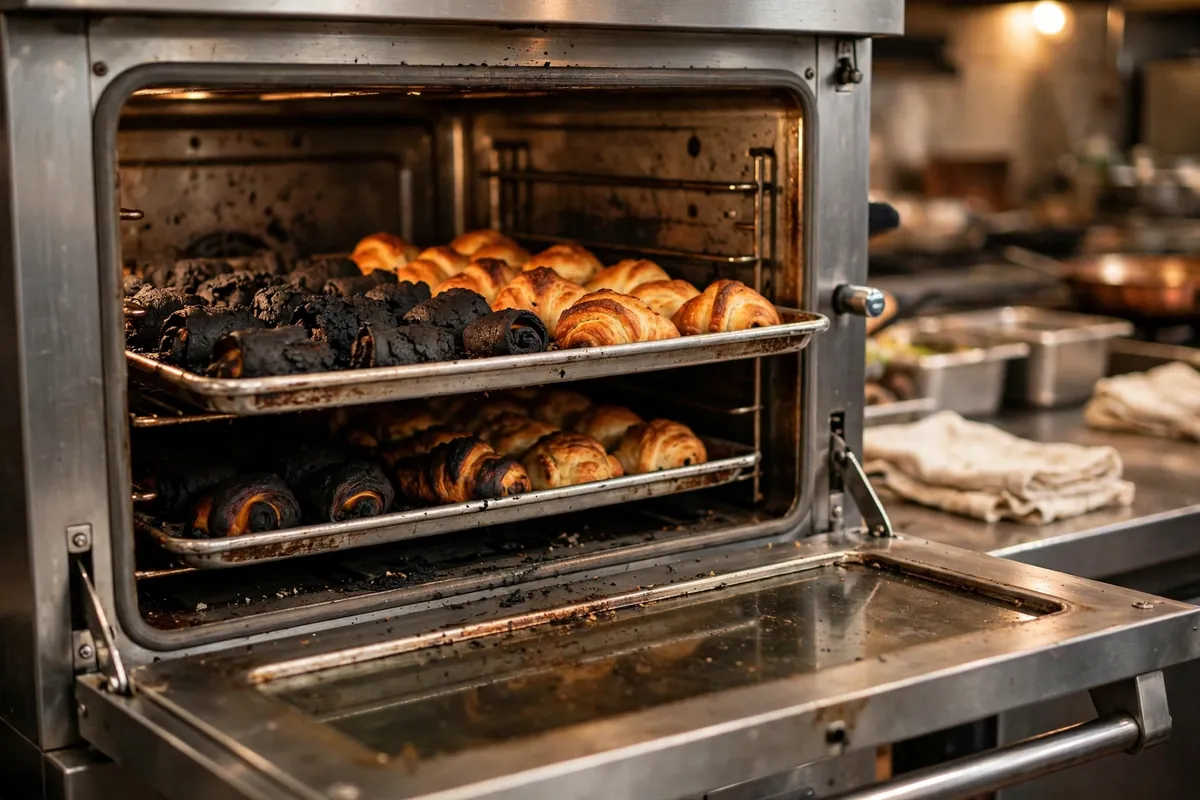
Uneven cooking indicates temperature distribution problems, because deteriorated door seals, failing convection fans, and calibration errors create hot spots. A worn convection fan cannot circulate heated air effectively, leaving some dishes undercooked while others burn during high-volume service. Temp drift makes it worse, because the dial heat strays from real oven heat, misleading cooks through service.
Test with an oven thermometer placed centrally, compare readings with the display, and check the door seal for gaps. Rotate trays during service temporarily, but arrange diagnostic testing promptly, because uneven cooking wastes ingredients and disappoints customers. Our technician tests the thermostat, inspects the convection fan, recalibrates temperature regulation, and replaces deteriorated seals to restore cooking.
Table 1 — Symptom, cause, and next step
| Symptom | Possible cause | Next step |
|---|---|---|
| Reach-in fridge running warm | Dirty coils or worn door gaskets | Clean coils, test gaskets, then call |
| Ice machine making little ice | Scale on evaporator or clogged water filter | Check filter date, run a clean cycle, then call |
| Commercial dishwasher not sanitizing | Failed heater, booster, or low water temperature | Check water temp, stop service if unsafe, then call |
| Range or fryer not holding heat | Worn thermostat or weak burner | Test with a thermometer, then call |
02 — Diagnosis
What we check on a commercial appliance repair bend visit
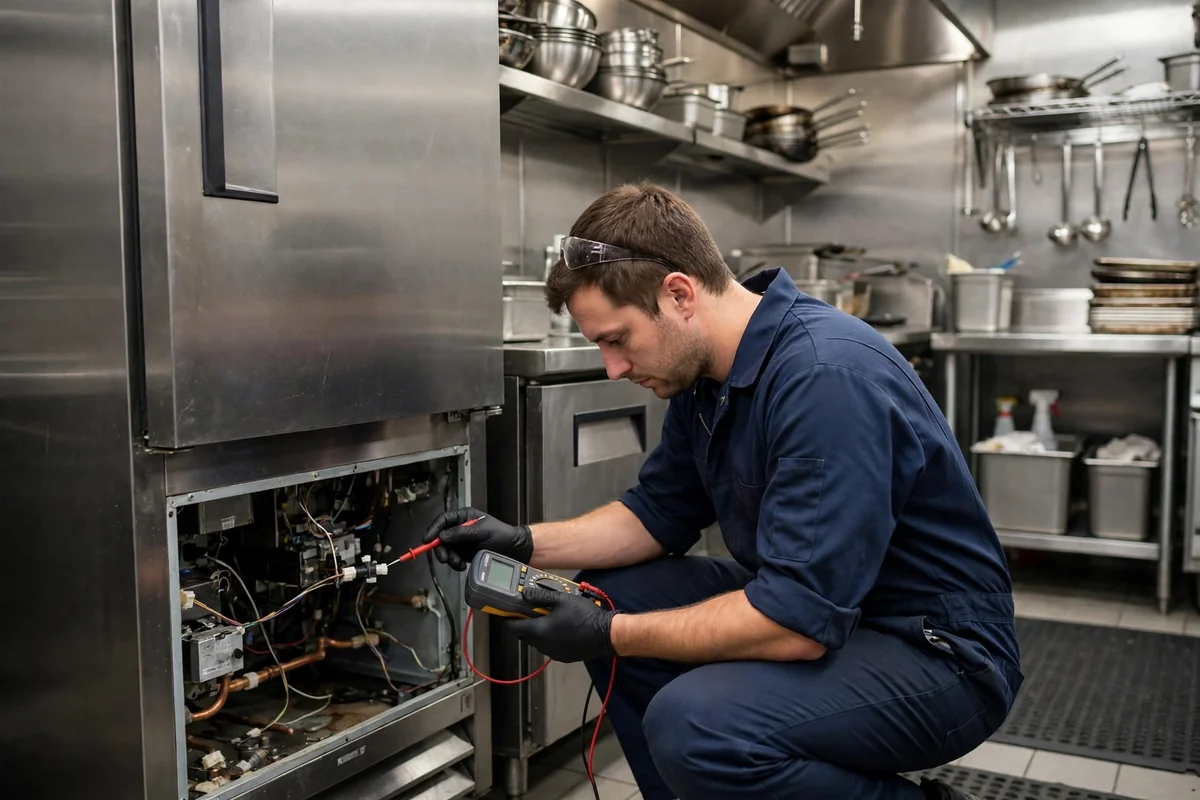
A good diagnosis saves money, so we test parts in order, from the likeliest fault to the least likely. We show you what we found, and these are the parts and terms we check most: reach-in refrigerator, walk-in cooler, ice machine, commercial dishwasher, door gasket, compressor, condenser coil, evaporator fan, water filter, sanitizing temperature.
| Part | Symptom it causes | What we check |
|---|---|---|
| Condenser coil | Warm fridge, high bills | Clean grease and dust, test cooling |
| Door gasket | Warm air leak, frost | Seal test, replace gasket |
| Ice machine scale | Slow ice production | Descale evaporator, test water filter |
| Dishwasher heater | Not reaching sanitizing temp | Test heater, booster, thermostat |
| Walk-in fan | Alarm, warm cooler | Test fan, compressor, door seal |
Each visit follows a set order, testing cooling, wiring, and temp control before we choose repair or a swap. Accurate diagnosis protects food safety, minimises downtime, and prevents unnecessary component replacement across every commercial kitchen we serve.
| Component | Typical lifespan | When it fails |
|---|---|---|
| Compressor | 7–12 years | Warm fridge, constant running |
| Door gasket | 3–5 years | Frost, warm air leaks |
| Dishwasher heater | 5–8 years | Will not sanitize |
03 — Repair or replace
Repair or replace? An honest answer for commercial appliance owners in Bend
We use the 50% Rule. If the repair costs more than half of a new commercial appliance, replacement usually makes more sense. If it costs far less, repair usually wins, and age matters too. Small parts on young machines are almost always worth fixing, while major faults on old machines rarely are. For commercial appliance repair bend, we give you the quote and your machine's age, then decide together.

Interactive tool — the 50% Rule
Repair or replace? Check in 10 seconds.
Type the numbers from your quote. If the repair costs more than half of a new unit, replacement usually makes more sense.
Repair is 28% of replacement cost.
Repair usually wins. The fix costs less than half of a new unit, and the appliance has life left.
This is a guide, not a quote. A technician confirms the fault and the real price on the visit.
| Situation | Repair cost | Our honest advice |
|---|---|---|
| Under 7 years, coil or gasket | Less than half the cost of new | Repair — usually the smart choice |
| 7–10 years, compressor or heater | Near half the cost of new | Get a quote first, then decide |
| Over 10 years, major failure | More than half the cost of new | Replace — downtime costs more |
| Any age, filter or clean | A small repair | Repair — fast and worth it |
04 — Your visit
How a visit works
1
Call or book online
Call or book online and describe the fault so we bring the right parts.
2
On-site diagnosis
We diagnose on site and give you upfront flat-rate pricing.
3
We fix it fast
Same-day service where possible, with genuine OEM parts fitted by a local technician.
4
90-day guarantee
Every repair carries a 90-day parts and labour guarantee, and we test a full cycle before we leave.

Commercial appliance repair Bend visits begin with urgent diagnostic inspection, because downtime costs revenue and risks food safety. We test cooling flow, compressor power, and temp settings, then check door gaskets, coils, and wiring. The vehicle carries common replacement components, including door gaskets, thermostats, and fan motors, enabling immediate installation during most visits. Diagnosis ends with a quote covering parts and labour, plus advice about whether repair or replacement offers better value. The technician verifies temperature regulation, tests safety controls, and confirms operation before completing the visit and explaining the warranty.
Specialist components sometimes require ordering, and the technician explains the timescale clearly while scheduling a return visit promptly. Walk-in cooler emergencies receive priority attention, because food safety depends on rapid temperature restoration and immediate diagnostic response. The 50% Rule guides every recommendation, because replacement often costs less than repeated repairs and downtime for ageing units. Payment follows the quote, which covers parts and labour, and a 90-day warranty protects every commercial repair we complete. Same-day service is available where possible, so early calls give your kitchen the best chance of a diagnostic visit.
05 — Choose well
How to choose a commercial appliance repair bend team in Bend
- Ask how fast they can reach you when food is at risk, since every hour costs a business.
- Ask for the quote before any work starts, so you know the full cost upfront.
- Ask if the repair is worth it for the age of the unit, or if replacement makes more sense.
- Check they test temperature after the fix, not just fit a part and leave.
- Check they are local to Bend, not a distant call centre, so the technician knows the area.
- Ask how quickly the team responds when food safety is at risk, because refrigeration downtime costs revenue.
- Check that the team tests temperature regulation thoroughly after every fix, rather than simply fitting a part.
06 — Bend climate
Bend's high-desert climate and your commercial appliance
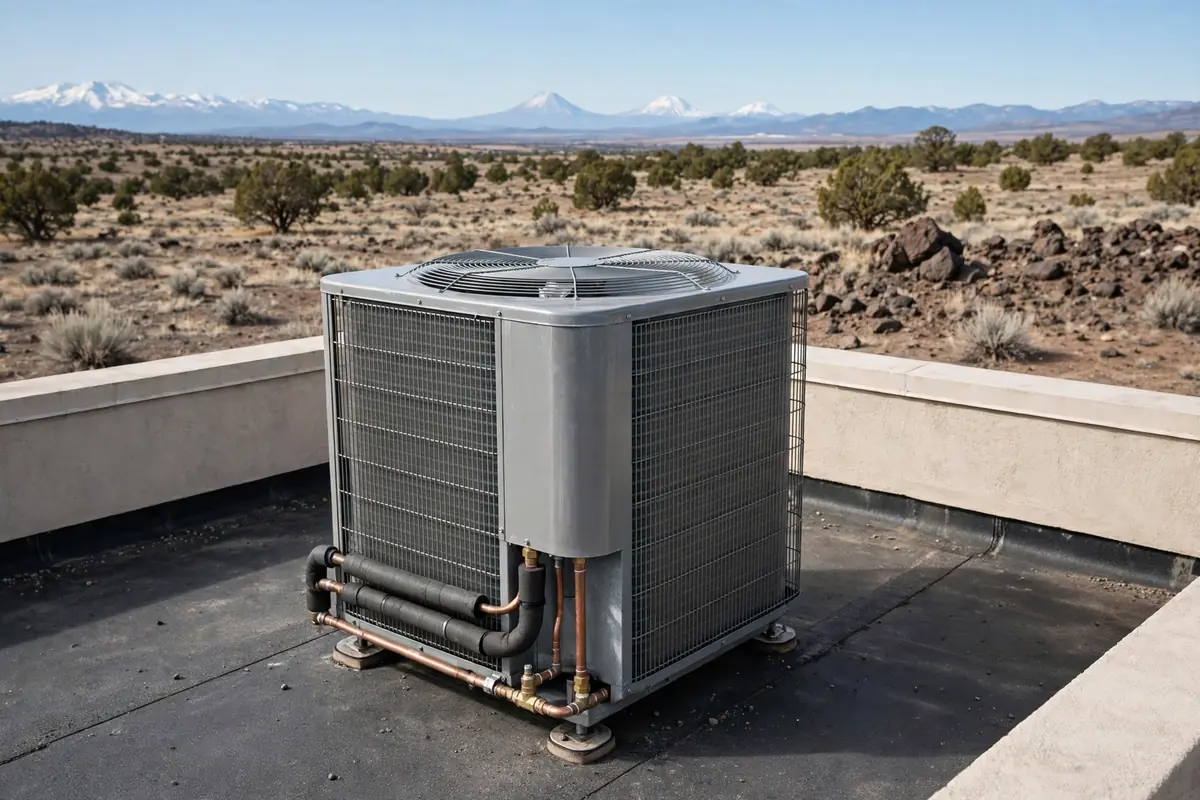
Bend's tourist summers load commercial kitchens hard, and fridges and ice machines run at peak on hot weekends. Dust and grease coat coils, and winter cold can freeze lines in unheated storage. We check coils, gaskets, and filters with peak season in mind. Commercial kitchens must follow the food safety rules — the FDA Food Code covers fridge temperatures and cleaning. Grease and heat can start grease fires — keep vents and hoods clean.
Seasonal stresses to watch for
- Commercial appliance repair bend teams check seasonal equipment before opening weekend. Idle winters let dust build up, damp seep in, and wiring wear.
- Hard water leaves scale build-up in ice machines and dishwashers, wasting energy, slowing water flow, and speeding rust.
- Vacation rental kitchens face contamination accumulation between guest stays through intermittent occupation. At 3,600 feet, dry high-desert air dries door gaskets faster, so regular inspection protects refrigeration efficiency year-round.
Commercial appliance repair Bend accounts for high-desert conditions, where elevation, dry air, dust, and temperature swings challenge kitchen equipment. Hot tourist summers push commercial refrigeration hardest, because busy July weekends demand continuous cooling while kitchen temperatures soar. Desert dust and kitchen grease combine, coating condenser coils with contamination that reduces heat transfer efficiency and strains compressors. Wildfire smoke adds another burden, clogging ventilation filtration, coating condenser surfaces, and forcing refrigeration systems to operate longer. Cold winters bring risks, because unheated storage areas expose water lines, condensate drains, and refrigeration components to freezing temperatures.
What Bend neighbours say
We collect reviews from real customers after every visit and publish them with their permission. No review appears here until it is real and verified — all stats to be confirmed before going live. The live site describes the business as family-owned since 2014, licensed, insured, and 5-star rated on Google.
07 — FAQs
commercial appliance repair bend — frequently asked questions
Short, direct answers, each starting with the point, so it works for readers and for AI answers too.
We prioritise commercial calls because downtime costs money for your business. Call early and tell us the unit type and the fault. We diagnose on the visit and quote before work. [TO VERIFY] Confirm response times with the business.
Yes — slow ice is often scale or a clogged filter from Bend's hard water. We descale, test the water filter, and check the condenser.
Stop service until the temperature is right, and check the incoming water temperature and the heater light. We test the heater, the booster, and the thermostat.
Yes — we work with restaurants, cafes, and shops across Bend, including downtown and the Old Mill District. We also cover Redmond and Sunriver.
For coils, gaskets, and filters, repair is usually worth it. For a compressor fault on a unit over 10 years old, replacement often costs less than downtime. We use the 50% Rule to help you decide.
Ask about a maintenance visit for coils, gaskets, filters, and temperature checks. Regular checks catch faults before a busy weekend. [TO VERIFY] Confirm maintenance plans with the business.
Move high-value stock to a working refrigerator, keep failed-unit doors closed, and call (541) 422-4646 for priority diagnostic assistance. Note the alarm code and temperature, because this helps our technician identify whether compressor, fan, or thermostat caused failure. Do not discard food until exposure is assessed, and our technician prioritises emergencies where food safety is at risk. Same-day service is available where possible, so early calls during service give your kitchen the chance of temperature restoration.
Schedule pre-summer maintenance, including condenser cleaning, gasket inspection, and temperature calibration, before peak tourist demand strains refrigeration equipment. Clean condenser coils, because grease accumulation and desert dust restrict heat transfer efficiency and force compressors to operate continuously. Train staff to close refrigerator doors promptly, report unusual noises immediately, and monitor temperatures throughout every busy service period. Descale ice machines and dishwashers, because Bend hard water leaves sediment accumulation that reduces efficiency and accelerates internal corrosion.
We also fix commercial appliances across Central Oregon
The same team serves Redmond, Sisters, Sunriver, La Pine, and Bend neighbourhoods, so choose your area for local details.
Other services in Bend
Request a visit
Tell us the appliance and the symptom — we reply with a visit slot.
Need commercial appliance repair bend?
Call (541) 422-4646 — Mon–Sat 8am–6pm. Tell us the fault, and we will book a visit and give you a clear quote before work starts.
Call (541) 422-4646