
Bend, Oregon · Family-owned since 2014
Washer Repair Bend OR
A broken washer stops the whole house, and laundry piles up fast while a leak can damage floors. Our Bend team fixes washers like every appliance: find the cause, explain it plainly, repair it properly.
Also searched as: washer repair bend oregon · washing machine repair bend or · washer repair in Bend.
On every visit
- 1Call or book online
- 2On-site diagnosis — upfront flat-rate pricing
- 3We fix it fast with genuine OEM parts
- 490-day parts and labour guarantee
Mon–Sat 8am–6pm · 56857 Enterprise Dr, Sunriver, OR 97707, USA
Since 2014
Family-owned in Bend
Licensed & insured
Local team, not a call centre
Bend · Redmond
Central Oregon served
Mon–Sat 8am–6pm
Call for a visit
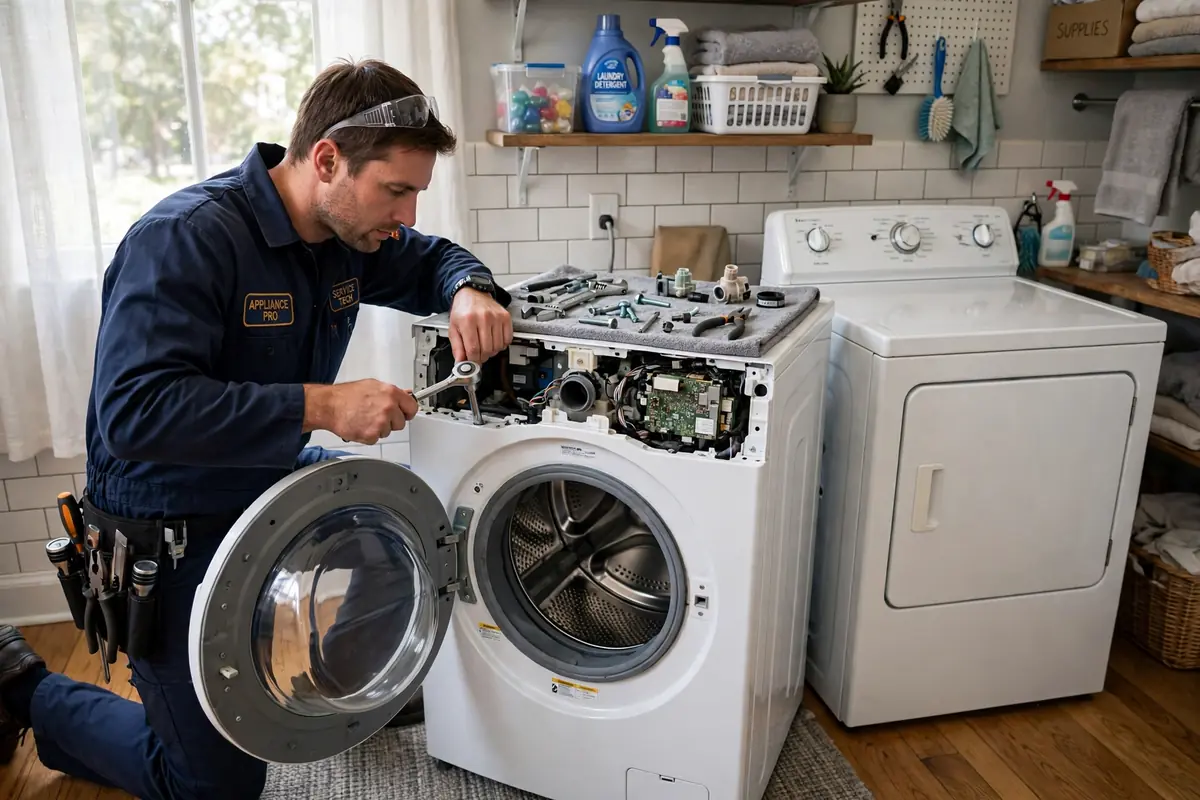
Washer repair Bend OR covers top-load and front-load machines. We fix spin faults, drain faults, leaks, shaking, and machines that will not start. We work across Bend, Redmond, and Central Oregon, in homes old and new.
Bend's hard water and dry air matter here, as scale builds up in valves and pumps. Dust gets into vents and motors, so we check for both. A fix that ignores hard water often fails again.
What to know before you call
- Washing appliances serve Bend households for approximately a decade, although mineral-rich water accelerates deterioration in valves and elastomeric seals.
- Mineral sediment accumulates inside inlet valves, restricting water circulation and forcing the appliance through incomplete intake cycles.
- Scheduling washer repair bend or inspections proactively prevents sediment deterioration from spreading to the drainage pump and transmission assembly.
- Drive belts elongate, suspension dampers weaken, and elastomeric door seals deteriorate with age, producing symptoms experienced technicians recognize immediately.
- Family-owned since 2014, our team serves Bend, Redmond, and Central Oregon. We know Old Mill closets and second-floor utility rooms, and every repair carries a 90-day parts and labour warranty.
Bend has many older homes near the Old Mill District and newer builds in Northwest Crossing and Mountain View. Older homes often have tight laundry closets and old drain lines. Newer homes often have front-load machines on second floors, where a leak spreads fast. We check the install, not just the machine.
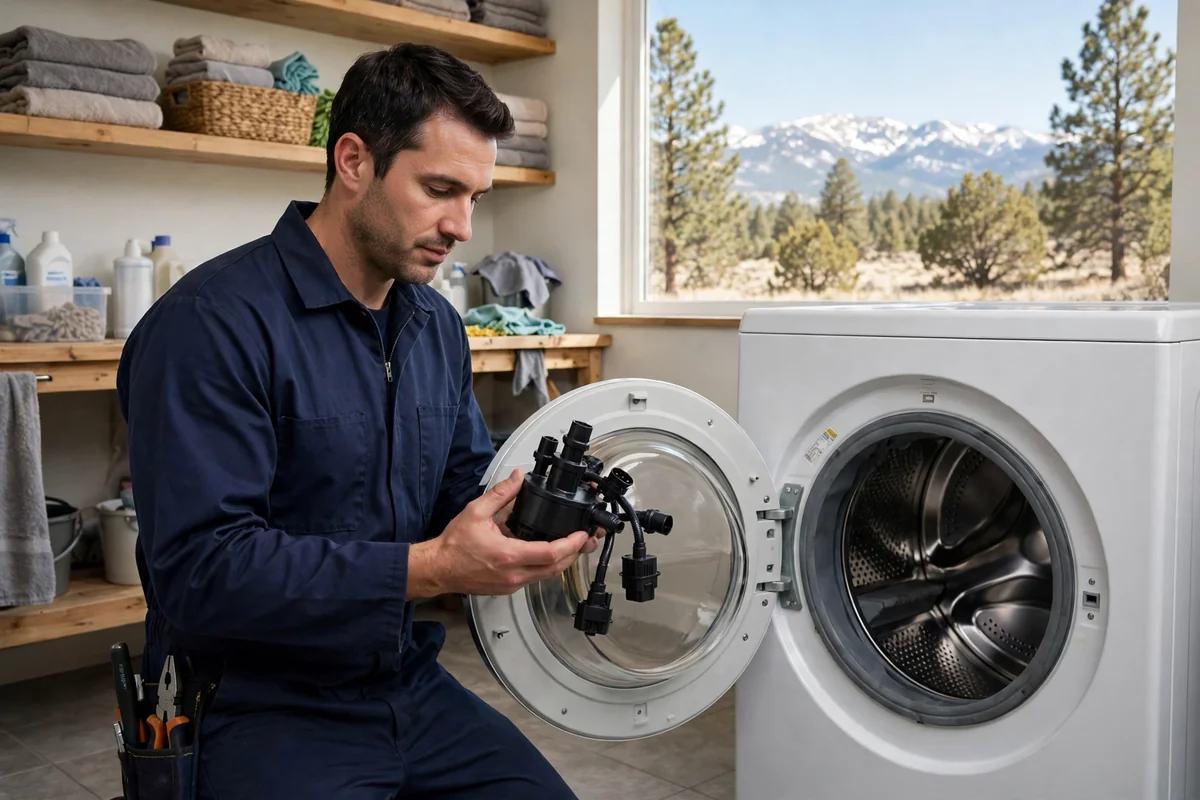
A washing appliance processes hundreds of laundry loads annually, agitating, rinsing, and extracting moisture through demanding mechanical cycles. Those repetitive cycles progressively deteriorate bearings, drive belts, and elastomeric seals, diminishing operational efficiency long before complete mechanical failure. When malfunctions develop, washer repair bend or delivers diagnostic evaluation to your laundry room, identifying the failing component first. Front-load and top-load configurations malfunction differently, because their transmissions, suspension assemblies, and drainage mechanisms follow entirely different engineering designs. Our technicians understand both configurations thoroughly, evaluating motors, drainage pumps, and control systems to isolate the source of malfunction.
01 — Symptoms
Signs your washer needs attention
These are the faults we see most often in Bend homes, and every one has a clear cause. Each fault also has a safe next step, and we explain both below. If your symptom is not listed, call and describe it, because the cause is usually one of these.
Why is my washer not spinning?
A washer that fills but will not spin often has a worn drive belt or a broken motor coupler. A faulty lid switch can cause the same fault, as the motor runs but the drum gets no drive. Either way, clothes come out soaking wet.
Check the lid switch first, push it down, and listen for a click. Check the load is balanced, and if the drum still will not spin, switch the machine off. We test the belt, the coupler, and the motor on site.
Why is my washing machine not draining?
A washer that will not drain usually has a clogged drain pump filter. Coins, lint, and small items collect there, and the pump hums while water stays in the drum.
Find the filter hatch at the front, low down, and put towels and a tray under it. Open it slowly and clear the debris from inside the filter. If water still will not drain, the pump itself may be blocked or worn. We test the pump and the drain hose.
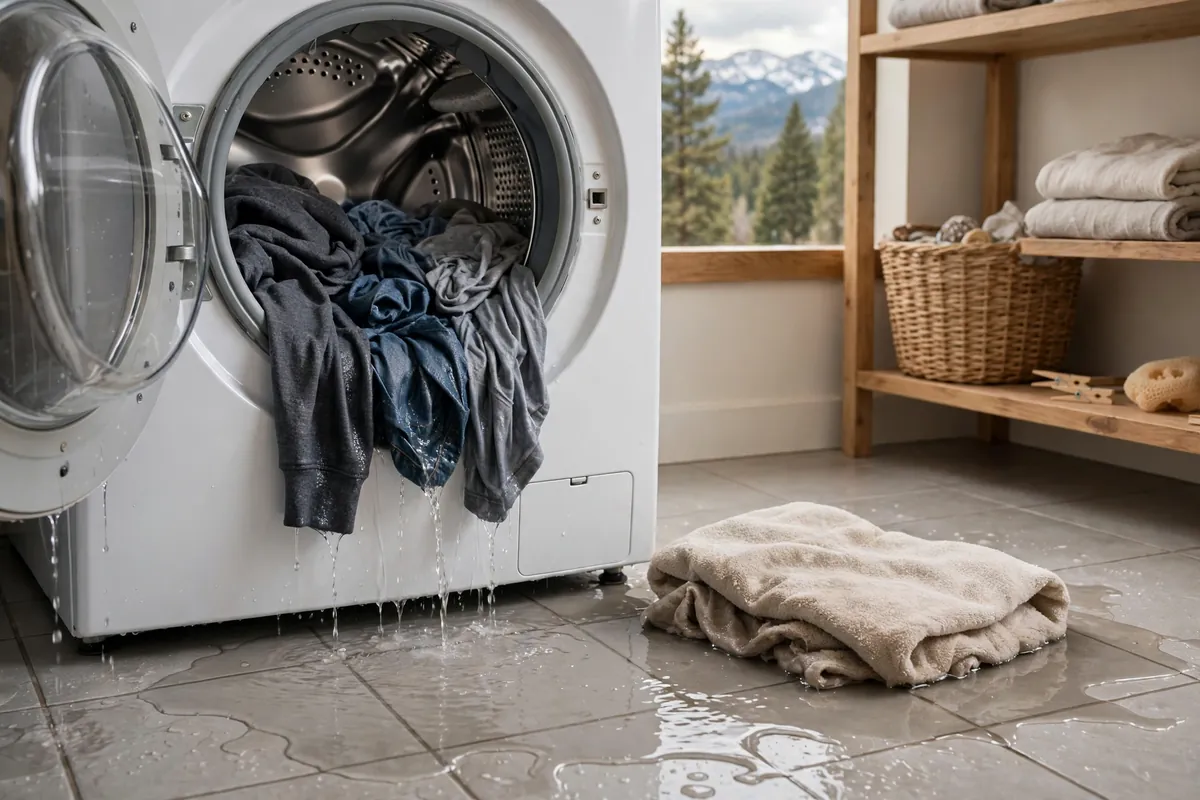
Why is my washer leaking water from the bottom?
Leaks from the bottom often come from a front-load door boot seal or a loose drain hose. Dry Bend air can crack rubber seals over time, and hard water scale makes seals wear faster.
Check the hoses at the back for drips, and look at the door seal for tears or mould. Turn the water off if the leak is steady. We replace seals and hoses, and check the drain line for a blockage that pushes water back.
Why is my washing machine shaking during the spin cycle?
A washer that shakes hard is usually out of balance or out of level. Heavy loads on one side throw the drum off centre, and worn shock absorbers make it worse. A laundry room on a wood floor shakes more.
Stop the cycle and spread the load evenly, then check the feet with a level. If it still walks across the floor, the shocks or springs may be worn. We test the suspension and level the machine properly.
Why is my washer filling so slowly?
Slow water intake typically indicates a deteriorating inlet valve, where mineral sediment from hard water gradually restricts internal passages. Inlet filtration screens accumulate the same sediment, and a partially closed supply valve can mimic a genuine mechanical failure.
Verify both supply valves are completely open, then evaluate the inlet filtration screens for visible sediment accumulation. If circulation remains restricted, contact our team for a diagnostic inspection of the valve, filtration screens, and water pressure. Valve replacement remains relatively straightforward, and most washer repairs cost $150–$400 according to our cost guide.
Why is my washer making a grinding noise?
A grinding noise during agitation or centrifugal extraction typically indicates bearing deterioration or an object trapped near the drum. Bearings support the drum through thousands of high-speed rotations, so gradual mechanical deterioration eventually produces a harsh metallic sound. Coins, bra wires, and small metallic fasteners slip through drum perforations, lodging against the tub and scoring interior surfaces.
Stop the appliance immediately if grinding intensifies, because operation can destroy the bearing housing and damage the transmission assembly. Inspect pockets before every load, and contact our team to evaluate the bearings, drum, and drive assembly. Early bearing replacement costs considerably less than transmission replacement, and our technicians carry common bearings for same-day repairs.
Why do my clothes come out with detergent residue?
Detergent residue typically indicates incomplete rinsing, frequently because mineral-rich water interferes with proper detergent dissolution and dilution. Overloading the drum restricts water circulation, trapping detergent residue inside the centre of a tightly compacted laundry load. A partially obstructed dispenser drawer produces the same effect, releasing detergent too late for adequate dilution and rinsing.
Load the drum loosely, measure detergent carefully, and clean the dispenser drawer monthly to prevent sediment accumulation. If residue persists, our technicians evaluate the inlet valve, drainage pump, and dispenser mechanism for sediment accumulation or malfunction. We additionally evaluate water pressure, because insufficient pressure undermines every rinse cycle and leaves detergent embedded in fabric fibres.
Table 1 — Symptom, cause, and next step
| Symptom | Possible cause | Next step |
|---|---|---|
| Washer not spinning | Worn drive belt, broken motor coupler, or lid switch | Check the lid switch and load balance, then call |
| Washer not draining | Clogged drain pump filter or blocked pump | Clear the filter, then book a pump test |
| Washer leaking from the bottom | Torn door boot seal or loose drain hose | Turn water off if leaking, then call us |
| Washer shaking violently | Unbalanced load, unlevel feet, or worn shocks | Rebalance the load and level the feet, then call |
02 — Diagnosis
What we check on a washer repair bend or visit
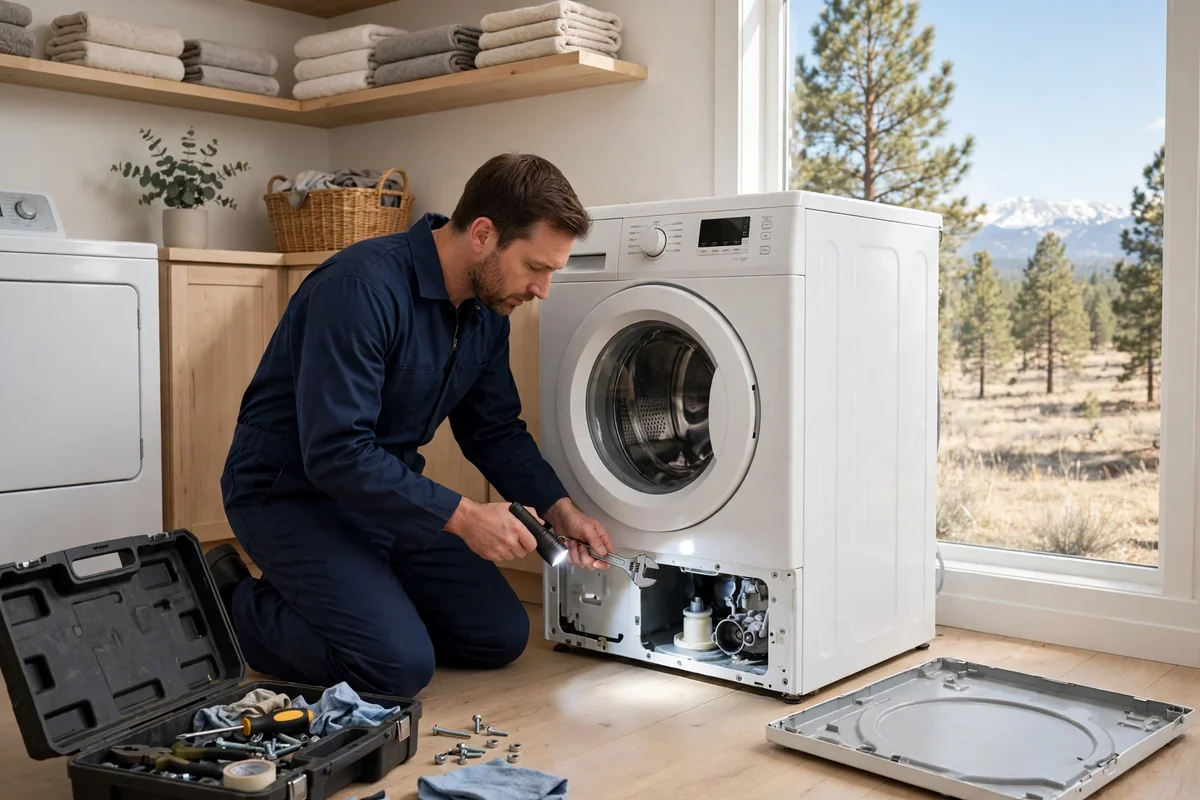
A good diagnosis saves money, so we test parts in order, from the likeliest fault to the least likely. We show you what we found, and these are the parts and terms we check most: drain pump filter, drive belt, motor coupler, door boot seal, spin cycle, water inlet valve, lid switch, shock absorbers, drain hose, control board.
| Part | Symptom it causes | What we check |
|---|---|---|
| Drain pump filter | Water stays in the drum | Clear filter, test pump and drain hose |
| Drive belt | Drum will not spin | Check belt wear, test motor and coupler |
| Door boot seal | Leak from the front, mould smell | Inspect seal, replace if torn or cracked |
| Shock absorbers | Violent shaking on spin | Test suspension, level machine, replace shocks |
| Water inlet valve | Slow fill, no fill, hammering | Test valve, check hard-water scale |
Beyond standard diagnostic procedures, our technicians evaluate internal components that deteriorate gradually over extended operational periods. These components exhibit no obvious symptoms until the appliance stops mid-cycle, so early diagnostic inspection prevents sudden laundry disruption. Understanding typical component lifespans assists homeowners to evaluate repair against replacement with realistic expectations regarding remaining operational service life.
| Part | Expected lifespan | Failure warning |
|---|---|---|
| Drive belt | 5–8 years | Drum will not spin |
| Drain pump | 8–12 years | Water stays in drum |
| Door boot seal | 6–10 years | Front leak, mould odour |
03 — Repair or replace
Repair or replace? An honest answer for washer owners in Bend
We use the 50% Rule. If the repair costs more than half of a new washer, replacement usually makes more sense. If it costs far less, repair usually wins, and age matters too. Small parts on young machines are almost always worth fixing, while major faults on old machines rarely are. For washer repair bend or, we give you the quote and your machine's age, then decide together.
Interactive tool — the 50% Rule
Repair or replace? Check in 10 seconds.
Type the numbers from your quote. If the repair costs more than half of a new unit, replacement usually makes more sense.
Repair is 28% of replacement cost.
Repair usually wins. The fix costs less than half of a new unit, and the appliance has life left.
This is a guide, not a quote. A technician confirms the fault and the real price on the visit.
| Situation | Repair cost | Our honest advice |
|---|---|---|
| Under 8 years, pump or belt | Less than half the cost of new | Repair — usually the smart choice |
| 8–10 years, motor or control | Near half the cost of new | Get a quote first, then decide |
| Over 10 years, drum or tub fault | More than half the cost of new | Replace — put money into a new unit |
| Any age, filter or hose | A small repair | Repair — fast and worth it |
04 — Your visit
How a visit works
1
Call or book online
Call or book online and describe the fault so we bring the right parts.
2
On-site diagnosis
We diagnose on site and give you upfront flat-rate pricing.
3
We fix it fast
Same-day service where possible, with genuine OEM parts fitted by a local technician.
4
90-day guarantee
Every repair carries a 90-day parts and labour guarantee, and we test a full cycle before we leave.
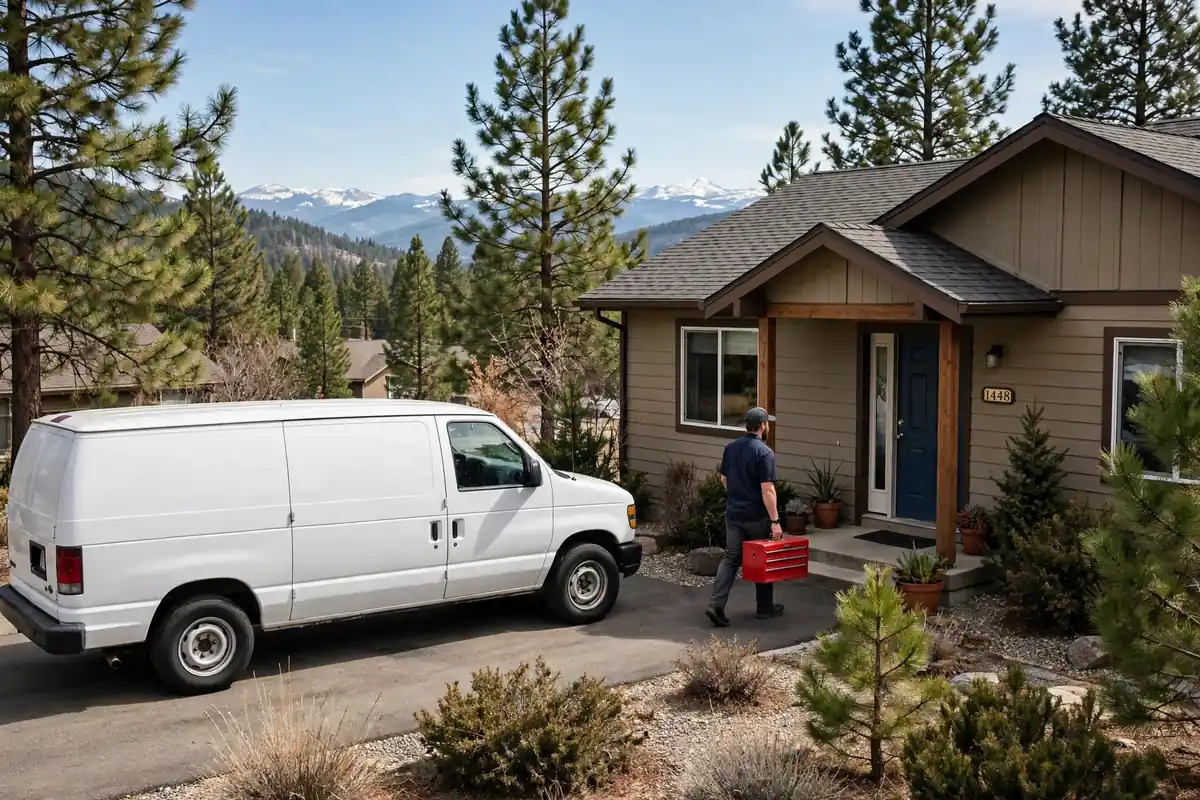
A washer repair bend or visit begins with systematic diagnostic testing, tracing the malfunction to its source before replacement. Our technician evaluates the drainage pump filter, the electric motor and drive belt, and examines the electrical connections. Once diagnostic testing confirms the malfunction, you receive a written quotation covering replacement parts, labour, and the diagnostic fee. Work commences only after you approve the quotation, and most washer repairs cost $150–$400 according to our cost guide. Our technicians carry frequently required replacement components, so many repairs complete in one visit without awaiting an ordered part.
After installing the replacement component, our technician operates a wash cycle, verifying water intake, agitation, drainage, and centrifugal extraction. That verification matters, because a washer can appear repaired while an underlying drainage pump malfunction continues undermining its performance. We additionally evaluate supply hoses and the drainage line, addressing deterioration that would otherwise cause another mechanical breakdown soon. Before departing, the technician clarifies the malfunction, the replacement component, and straightforward maintenance practices that prevent recurring mechanical breakdowns.
05 — Choose well
How to choose a washer repair bend or team in Bend
- Ask for the fault in plain words, not just a part name, so you understand the diagnosis.
- Ask if the repair is worth it for the age of the machine, or if replacement makes more sense.
- Ask for the quote before any work starts, so you know the full cost upfront.
- Check they test a full wash cycle after the fix, not just start the machine and leave.
- Check they are local to Bend, not a distant call centre, so the technician knows the area.
- Ask whether the technician inspects supply hoses and drain lines, not only the machine itself, during every visit.
- Check whether the repair includes a full test cycle, so spin, drainage, and fill work before departure.
06 — Bend climate
Bend's high-desert climate and your washer
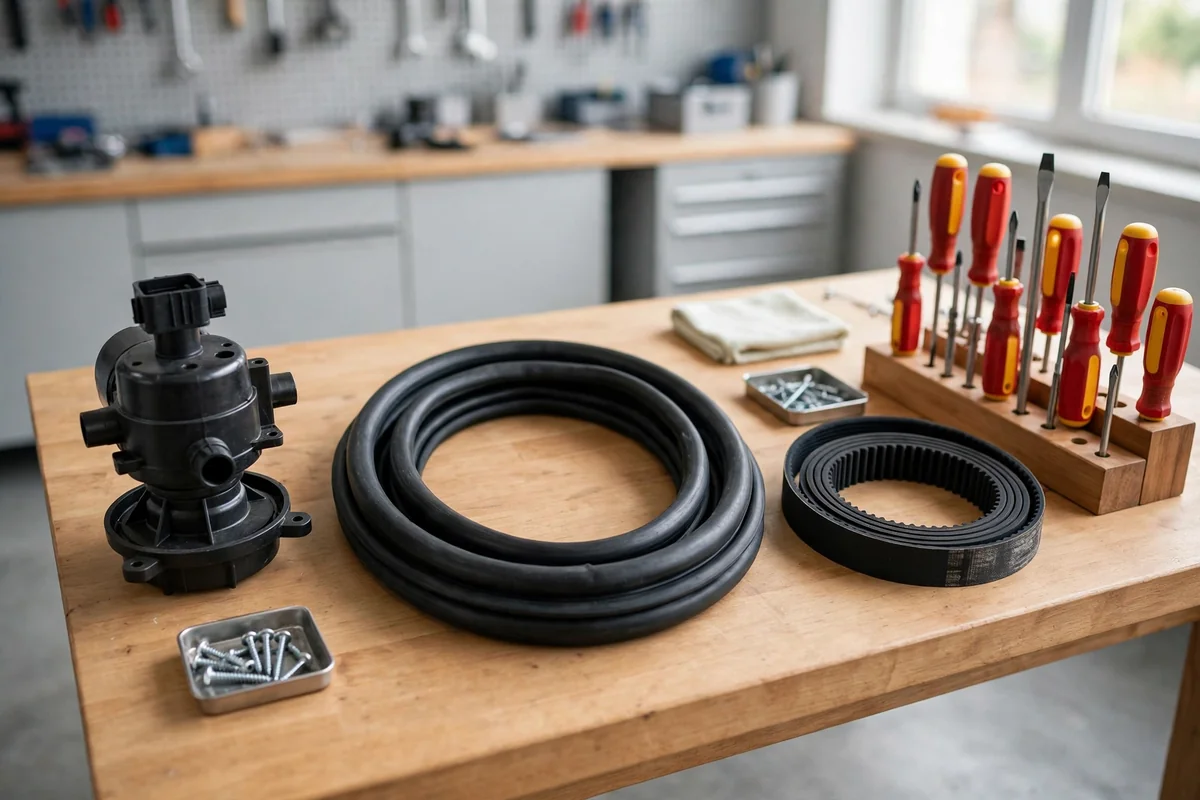
Bend's hard water leaves scale in washer valves and pumps, and dry air cracks rubber door seals. Dust reaches motors in laundry rooms near garage doors. In winter, a washer in a cold garage can freeze its hoses. We check water, seals, and frost risk on every washer visit. A full washer uses less water and energy, and the WaterSense tips show how to save water at home.
Seasonal stresses to watch for
- Many Bend households install washers in garages, exposing them to subfreezing winter temperatures regularly falling into the teens.
- Subfreezing conditions can rupture supply hoses and fracture drainage pumps, discharging water across the garage floor without warning.
- Vacation residences face identical hazards, with washer repair bend or technicians restoring appliances left dormant through extended winter absences. Deschutes County water deposits sediment in the intake system, progressively constricting passages until valves and drainage pumps malfunction.
Bend sits at 3,600 feet in the high desert, where arid conditions and mineral-rich water shape washer performance year-round. That climate makes washer repair bend or a year-round necessity, as mineral sediment accumulates in valves and drainage pumps. Arid air desiccates elastomeric door seals and supply hoses, producing fissures that leak water and force premature component replacement. Fine high-desert particulate contamination infiltrates electric motors and ventilation openings, insulating components against adequate cooling and accelerating electrical deterioration. Wildfire smoke contributes microscopic particulates to that contamination, coating internal mechanisms and demanding frequent diagnostic inspection and preventative maintenance.
What Bend neighbours say
We collect reviews from real customers after every visit and publish them with their permission. No review appears here until it is real and verified — all stats to be confirmed before going live. The live site describes the business as family-owned since 2014, licensed, insured, and 5-star rated on Google.
07 — FAQs
washer repair bend or — frequently asked questions
Short, direct answers, each starting with the point, so it works for readers and for AI answers too.
Most washer repairs in Bend cost $150–$400, and a replacement runs $600–$1,800. Both figures come from the business's own cost guide on bendorappliancerepair.com, checked 2026-11-08. We diagnose first and give a clear quote before work starts.
For a pump, belt, or seal, yes, it is worth repairing. For a drum, tub, or control fault on a machine over 10 years old, replacement is often better. We walk you through the 50% Rule.
The usual cause is a torn door boot seal or a blocked drain. Dry air and hard water wear seals out, so we inspect the seal and the drain line.
Open the low front hatch with towels and a tray under it, then turn the filter cap slowly. Clear coins and lint, then refit it, and if water still will not drain, the pump needs testing.
Mould grows in a damp door seal and dispenser drawer between washes. Wipe the seal dry after washes and leave the door open. If the smell stays, the seal or pump may need cleaning or replacement.
Codes point to drain, fill, door, or motor faults, so note the code and the model, then call. The code helps us bring the right part.
Yes, hard water deposits mineral sediment inside inlet valves, pumps, and hoses, gradually narrowing passages and reducing water flow. Sediment accumulation also stiffens rubber seals, causing cracks that leak and forcing premature replacement of expensive components. Our technicians inspect valves and seals for sediment damage during every visit, and recommend cleaning routines that slow accumulation. Using the correct detergent amount and running occasional hot cycles helps dissolve mineral deposits before they cause mechanical failure.
A washer stopping mid-cycle usually signals a drainage fault, an unbalanced load, or an overheating motor. Redistribute the load evenly, clear the drain pump filter, and restart the cycle to see whether the fault clears. If stopping continues, our technicians test the pump, motor, and control board to identify the underlying cause. Repeated mid-cycle stops deserve prompt attention, because an unresolved drainage fault can flood the laundry room without warning.
We also fix washers across Central Oregon
The same team serves Redmond, Sisters, Sunriver, La Pine, and Bend neighbourhoods, so choose your area for local details.
Other services in Bend
Request a visit
Tell us the appliance and the symptom — we reply with a visit slot.
Need washer repair bend or?
Call (541) 422-4646 — Mon–Sat 8am–6pm. Tell us the fault, and we will book a visit and give you a clear quote before work starts.
Call (541) 422-4646